Free open-source IDE
VSCodium-Rust on GitHub: Rust/Tauri, VS Code–compatible. The proprietary emulator runs on your hardware in Community mode—no license fee for local use.
Learn more →Overview
Investors and partners can read depth here. Pricing and CISA bundles live on the homepage (single source — no duplicate tables here). Core claim: Cyber-Ifrit delivers the first cross-platform iPhone-class emulator for Windows and GNU/Linux aimed at development and cybersecurity workflows.
Core Features
VSCodium-Rust on GitHub: Rust/Tauri, VS Code–compatible. The proprietary emulator runs on your hardware in Community mode—no license fee for local use.
Learn more →Agent Runtime links emulator frames with your repo so UI issues map to real code—not blind chat iterations.
Learn more →Local Ollama on your GPU, optional Cloud Inference subscription when you want managed capacity, or BYOK for any HTTP API—pick per workspace.
Learn more →Cyber-Ifrit Security Academy (CISA): Pro includes a limited, curated course bundle so you learn emulator and mobile security alongside Cloud Inference. Studio and ParrotSec OS Pro unlock deeper catalogs and org-scale programs.
Learn more →Innovation
We built the missing layer between a real device-class emulator and the agents that must understand it—not a slide deck, a runtime. The IDE, emulator, routing, and academy are one product story so teams can build and test on common desktop systems without giving up control.
A native IDE surface without the Electron tax: faster cold start, tighter memory, and a credible path for security review—while staying VS Code–compatible where it matters for extensions and workflows.
Ships open source · Community foreverAgents do not hallucinate taps when they can correlate UI frames with your repository state. Vision jobs and coder jobs share one traceable timeline so debugging is reproducible, not conversational roulette.
Proprietary local emulator · Your hardwareLocal Ollama, managed catalog, or BYOK HTTP—per workspace. High-throughput tiers add reserved concurrency for agent + vision pipelines; frontier models are designed to attach to your contracts, not surprise vendor bills on our P&L.
Flat platform seats · Usage follows your keysAgent workbench
CYBER-IFRIT layout — not a clone of any vendor IDE; a neutral dev-tool pattern for marketing clarity.
pub async fn align_vision_trace(frame: &SurfaceFrame, repo: &Workspace) -> GroundedPatch {
  // Correlate GPU-presented pixels with AST + diff — single timeline
  let anchor = repo.snapshot_sparse_index();
  let bundle = vision.extract_interaction_kernel(frame, anchor).await?;
  routing.dispatch(bundle, Policy::ByokPreferred)
}Universal Integrations
Cyber-Ifrit is the first IDE that works with any major AI provider and local model runtime.
GPT-4o, o1
Claude 3.5 Sonnet
Gemini 1.5
Ollama, LM Studio
Qwen, Llama 3
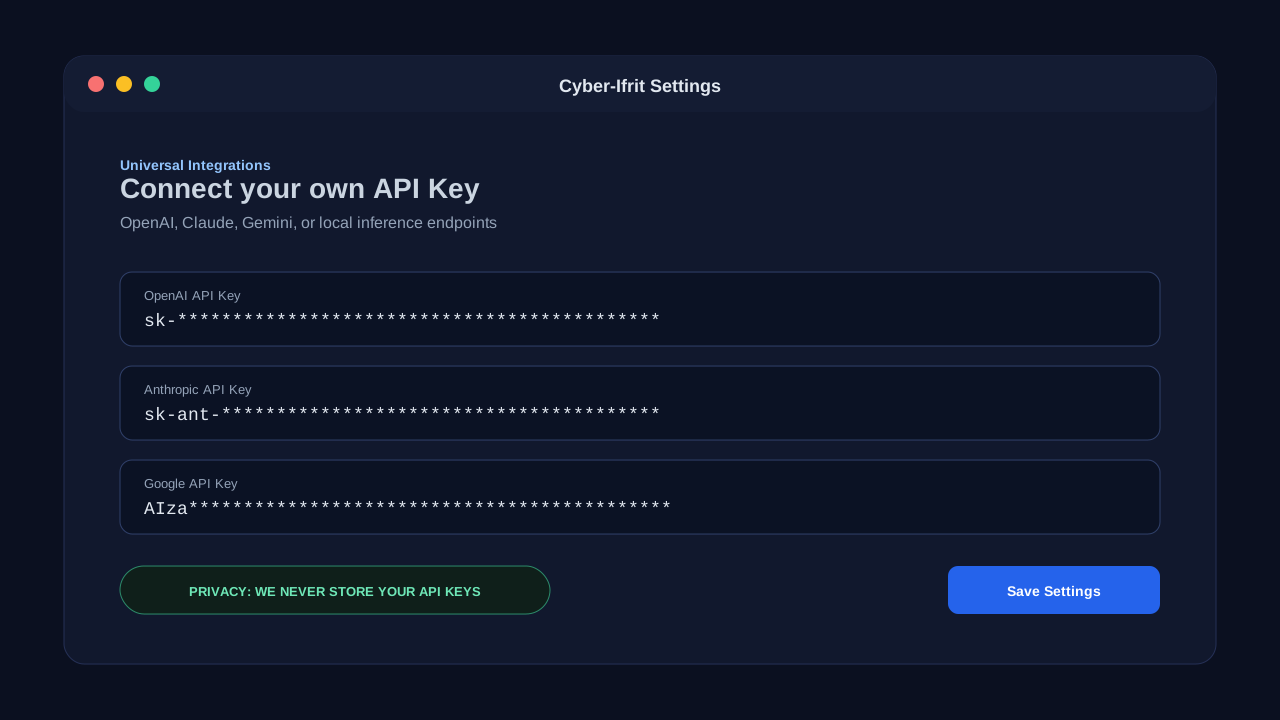
Connect any provider in one click. Switch models instantly. Your keys stay on your device.
Settings Screenshot — BYOK Input
Mission
No Mac showroom required. No opaque “trust our GPU” default unless you choose managed Cloud Inference—or stay on local Ollama entirely.
VSCodium-Rust pairs a Rust/Tauri editor with a proprietary iOS-class emulator for cybersecurity on Windows and Linux. Agent Runtime routes agents through Ollama—optional Cloud Inference when you want hosted capacity, plus local Ollama and BYOK. Flagship open weights include Qwen 3.6 35B abliterated and Gemma 4.
iPhone hypervisor emulator in the IDE on Windows or Linux—pentest, instrument, ship (guest closed-source with license). Not Apple's Xcode Simulator.
Models route through Cloud Inference, local Ollama, or BYOK—pick the path per workspace and policy.
$ vscodium-rust --profile sovereign
[+] KORTEX / hades-kernel · semantic map · JIT faults (attn ≥ 0.85)
[+] VRAM budget: local 8GB profile · thermal governor armed
[+] STYX emulator pane attached (iOS guest)
[!] Agent vision stream @ 60 FPS
[+] Ollama → cloud-inference (pooled) · qwen3.6-35b · gemma-4
[*] CLOUD_BURST=0 — BYOK idle — voice ready
Neon Genesis is for backers of iPhone-class emulator R&D only: a one-time pledge secures lifetime entitlement and support for that emulator (dev & cybersecurity use under license)—not the whole commercial IDE story, and not lifetime free Cloud Inference.
Limited time: Neon Genesis accepts new supporters for twelve months after we open enrollment, up to 100 cohort slots. When that year ends, no one else can claim this offer.
Cloud Inference stays a monthly subscription if you want managed inference, same as everyone else.
Neon Genesis & roadmap → Neon Genesis · $100 on Buy Me a Coffee →
FAQ
The iPhone emulator is tuned for cybersecurity and instrumentation, but the IDE + agent loop works like any serious dev environment—full device emulation with sovereignty and local or managed inference. This is not Apple's Xcode Simulator.
Your editor and emulator stay on your machine. Model traffic goes to the path you choose: Cloud Inference (managed Ollama), your own local Ollama, or BYOK endpoints you configure.
We center the stack on Qwen 3.6 35B (abliterated), Gemma 4, and other open-weight pulls via Ollama—expandable as the catalog grows.
Same philosophy as tools developers already pay for monthly: predictable cost for serious daily use, without usage cliff anxiety common in metered coding agents.
Frontier is a platform seat for teams that stress concurrent vision + coder agents across the emulator loop. The fee covers reserved routing lanes and integration work—not resale of frontier model tokens. Frontier is BYOK-first: you attach providers you already pay (Anthropic, Bedrock, Azure OpenAI, or other HTTP endpoints). Managed frontier pools may be quoted as explicit add-ons when we have negotiated capacity—we never bury uncapped frontier usage into a generic monthly line item.
Tiers, add-ons, and CISA bundle rules live on the homepage: Pricing (#pricing) and Academy billing (#academy-pricing). This Overview page is the product brief; Neon Genesis (emulator R&D backers, twelve-month pledge window) is summarized below on this page.
Pro includes a limited, curated set of Cyber-Ifrit Security Academy (CISA) courses—enough to get productive on the emulator stack and mobile security workflows without buying every track à la carte. Studio and ParrotSec OS Pro expand how many modules, labs, and org seats you can use. See the homepage section Academy billing (#academy-pricing) and the Academy catalog for certification paths (CMRA, CAPS, CDAD, verification).
KORTEX (AGPL-3.0) is our open neural VFS / context substrate—compact semantic maps, attention-aware JIT page-in, and VRAM-budgeted eviction so agents can reason over large trees without stuffing the entire repo into one prompt. It pairs with a runtime kernel + llama.cpp bridge on local 8GB-class GPUs; larger pooled hosts can run a relaxed cloud-burst profile so Cloud Inference stays shareable across many subscribers. Source and build instructions: github.com/H4D3ZS/kortex.
No—the emulator ships closed-source with the licensed workstation. Public GitHub material covers editor-facing references only.
Get started
Community is the free open-source IDE; the proprietary iPhone-class emulator runs on your machine. Pro adds managed Ollama plus a limited Cyber-Ifrit Security Academy bundle—see courses & certs. Studio · ParrotSec OS Pro unlock fuller Academy, team programs, and Security Sentinel + VPhone ($50/mo Pro tier — Community path stays free).